Bayesian vs. Frequentist MMM: Why Uncertainty Matters for Budget Decisions
Every modern MMM framework is Bayesian. Google Meridian, Meta Robyn (partially), PyMC-Marketing. If you are evaluating MMM tools, you will see the word "Bayesian" on every landing page. But most explanations stop at theory. Here is what it means for your actual budget decisions.
The 30-Second Version
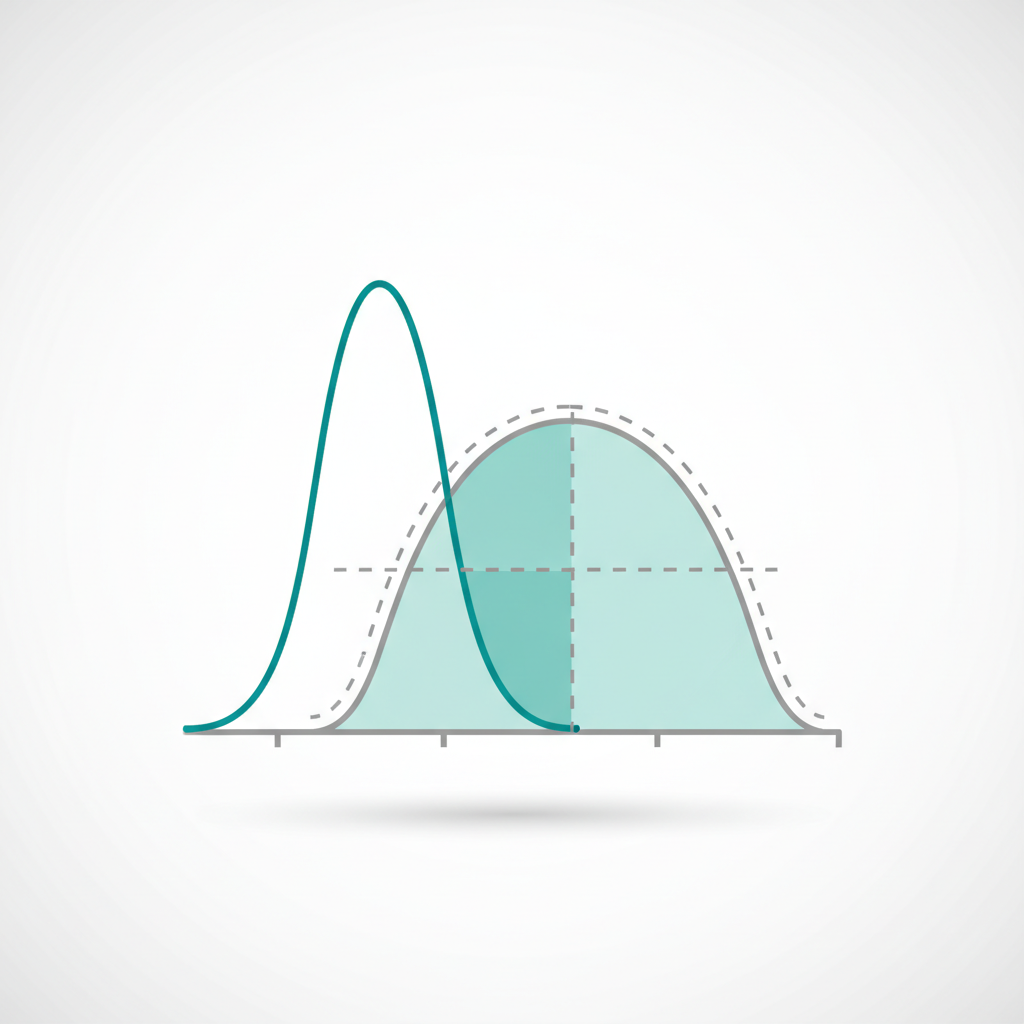
Frequentist MMM gives you one number: "Meta ROAS is 2.4x." Bayesian MMM gives you a range: "Meta ROAS is most likely between 1.6x and 3.3x, with the median at 2.4x."
That range is called a credible interval. It tells you how uncertain the model is. And that uncertainty is the single most important thing for budget decisions.
Why Uncertainty Changes Everything
Imagine two channels. Channel A has ROAS of 2.0x with a credible interval of 1.8x to 2.2x. Channel B has ROAS of 2.5x with a credible interval of 0.4x to 5.1x.
A frequentist model tells you Channel B is better. Period. Shift budget there.
A Bayesian model tells you Channel B might be better, but there is a real chance it is actually losing money. The wide interval means the model does not have enough signal. Betting your budget on it is risky.
This happens constantly with smaller channels. You spent $30K on podcasts last quarter. The point estimate looks great at 3.8x ROAS. But the credible interval is 0.2x to 8.1x because the model barely has enough data to distinguish podcast spend from noise. Without that interval, you might triple the podcast budget based on a number that is essentially a coin flip.
Credible Intervals vs. Confidence Intervals
Quick technical note. A Bayesian 90% credible interval means: "There is a 90% probability the true value falls in this range." A frequentist 90% confidence interval means: "If we repeated this experiment many times, 90% of the intervals would contain the true value."
The Bayesian interpretation is what you actually want. It answers the question you are asking: "Given my data, what is the probability that ROAS is above 1.0x?" Frequentist intervals cannot directly answer that question. This is not a philosophical debate. It changes what you can do with the output.
Priors: Your Secret Weapon
Bayesian models let you encode prior knowledge. If you ran a geo-lift test and found that TV ROAS is around 1.5x, you can set that as a prior. The model starts from your known result and updates based on new data.
Without priors, a model looking at 2 years of weekly data might produce nonsensical results for channels with low spend variance. "Radio ROAS is 12x" because you spent the same amount on radio every single week and the model confused it with a seasonal trend.
Priors prevent that. They keep the model honest.
A Real Example
A DTC skincare brand was spending $180K/month across 5 channels. Their frequentist MMM said to shift $40K from Google to TikTok based on estimated ROAS.
When they reran with a Bayesian model, TikTok's credible interval was 0.8x to 4.2x. Google's was 2.1x to 2.9x. The point estimates favored TikTok, but the uncertainty told a different story: Google was a safer bet. They shifted $15K instead of $40K and ran an incrementality test on TikTok to reduce uncertainty before committing more.
That is the kind of decision Bayesian MMM enables. Not just "what is the best estimate" but "how confident should I be, and how much should I bet?"
Want to see credible intervals in action? Check our interactive demo report where every metric includes its uncertainty range.
Ready to see what your budget is actually doing?
Start your free trial. Upload your data, get your first MMM report in days, not months.
Start your free trial