MMM vs. MTA vs. Last-Click: Which Attribution Model Do You Actually Need?
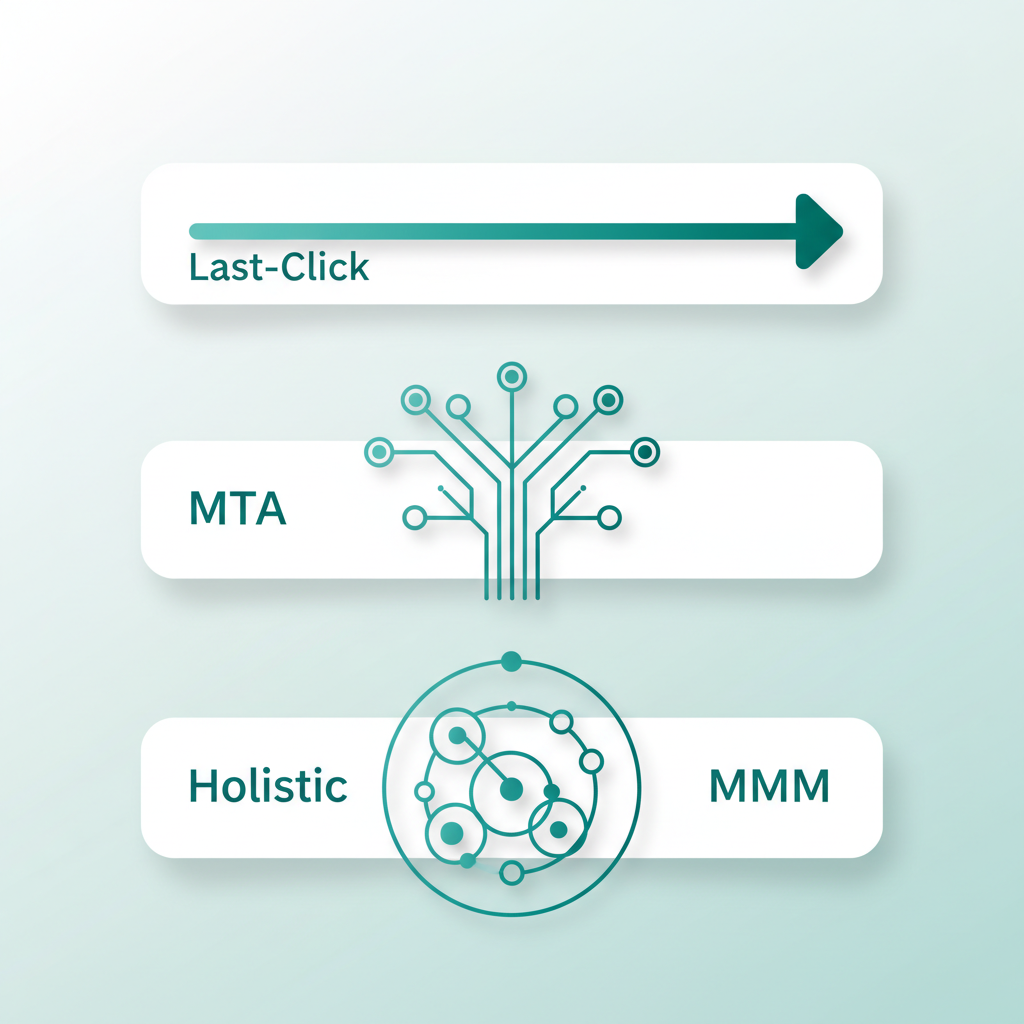
You have three main options for understanding which marketing channels drive results: Marketing Mix Modeling (MMM), Multi-Touch Attribution (MTA), and Last-Click Attribution. Each answers a different question, and picking the wrong one wastes time and budget.
Last-Click Attribution: The Default That Lies to You
Last-click gives 100% of the credit to the final touchpoint before conversion. It is the default in Google Analytics and most ad platforms.
The problem is obvious: if someone sees your YouTube ad, clicks a Facebook retargeting ad, then converts via a branded Google search, Google Search gets all the credit. YouTube and Facebook get zero. So you shift budget toward branded search (which would have converted anyway) and away from the channels actually generating demand.
A real example: one DTC brand we worked with found that 40% of their conversions attributed to branded search in GA4 were actually initiated by TikTok ads 7-14 days earlier. Last-click was hiding their best-performing channel.
Multi-Touch Attribution: Better, But Broken by Privacy
MTA tracks individual users across touchpoints and distributes credit across the journey. It is a clear improvement over last-click because it acknowledges that conversions rarely happen in one step.
But MTA depends on user-level tracking. After iOS 14.5 (April 2021), roughly 75% of iOS users opted out of cross-app tracking. Cookie deprecation in Chrome, GDPR consent requirements, and ad blockers have further reduced the trackable population.
The result: MTA now sees maybe 30-50% of your actual conversions. It is like measuring your weight on a scale that only works half the time. The number you get is not necessarily wrong, but you cannot trust it.
Marketing Mix Modeling: The Privacy-Proof Option
MMM uses aggregated data. No cookies, no pixels, no user-level tracking. It works with the same data you already have: how much you spent on each channel each week, and what your outcomes were. Privacy regulations do not affect it at all.
The tradeoff: MMM operates at a weekly or daily granularity, not at the user level. It tells you "Meta drove approximately $420K in revenue this quarter with a ROAS of 2.8x." It does not tell you which specific users converted from Meta.
For budget allocation decisions, that is exactly what you need. You do not allocate budget to individual users. You allocate it to channels.
Quick Comparison
| Last-Click | MTA | MMM | |
|---|---|---|---|
| Privacy-proof | No | No | Yes |
| Offline channels | No | No | Yes |
| User-level | Yes | Yes | No |
| Data needed | Clicks | Full journey | Spend + outcomes |
| Setup time | Minutes | Weeks | Days to weeks |
| Best for | Quick directional reads | Journey analysis | Budget allocation |
Which One Should You Use?
If you are making budget allocation decisions across channels, use MMM. Period. It is the only method that measures all channels (including offline) without depending on cookies.
If you also need user-level journey insights for campaign optimization (like which creative variants perform best), keep your MTA running alongside MMM. They are complementary.
Last-click? Fine for a quick sanity check. Just never use it to make budget decisions. The numbers are directionally misleading for anything except bottom-funnel branded search.
Want to see what MMM output actually looks like? Check out a sample Spendmix report.
Ready to see what your budget is actually doing?
Start your free trial. Upload your data, get your first MMM report in days, not months.
Start your free trial