What is Marketing Mix Modeling? A Marketer's Guide for 2026
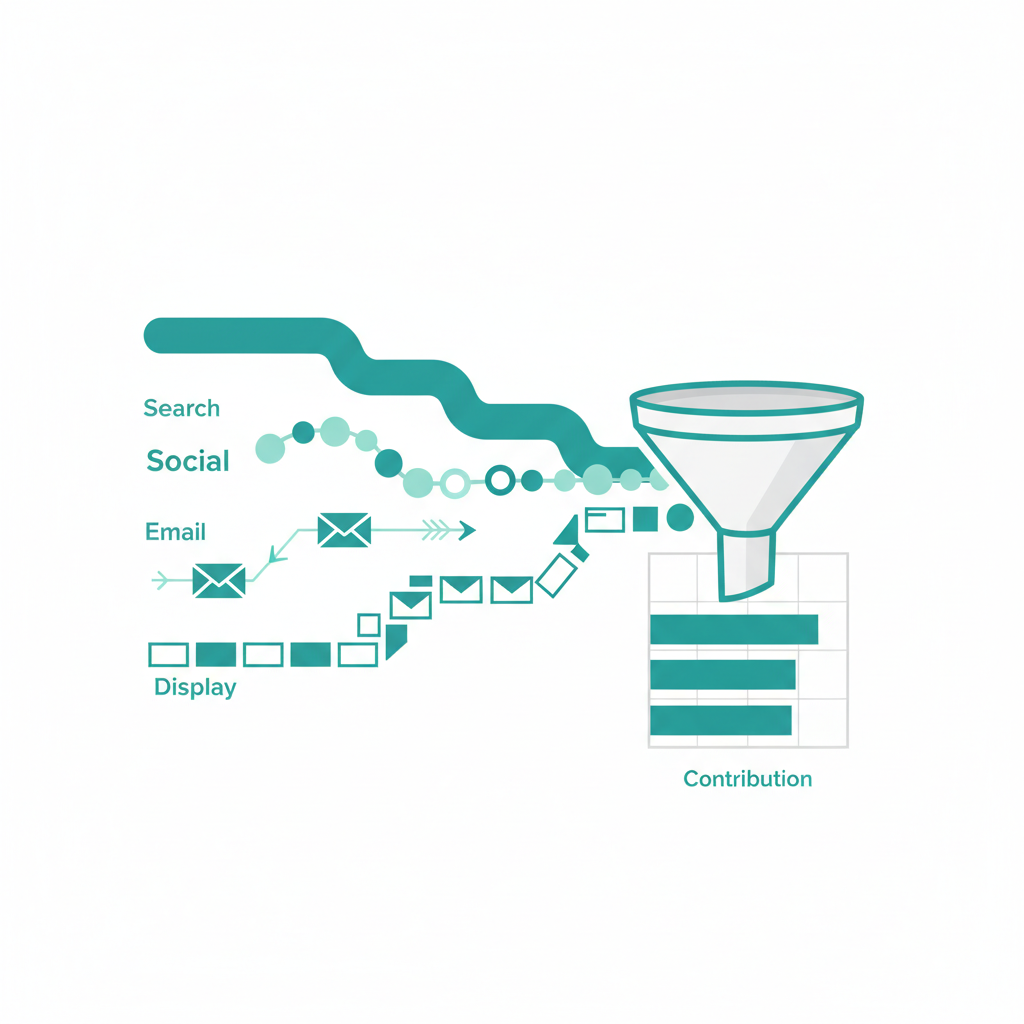
Marketing mix modeling (MMM) is a statistical method that measures how each of your marketing channels contributes to revenue. It looks at historical spend and outcome data across all channels at once, then estimates the incremental impact of each one.
Think of it this way: you spent $400K on Google Ads, $200K on Meta, $80K on TV, and $50K on podcasts last quarter. Revenue was $3.2M. MMM tells you how much of that $3.2M each channel actually drove, and how much would have happened anyway (your baseline).
Unlike pixel-based attribution, MMM does not depend on cookies or user-level tracking. It works with aggregated data, which is why it still functions when iOS privacy changes, ad blockers, and cookie deprecation break other measurement approaches.
How MMM Works in Practice
You feed the model weekly (or daily) data: spend per channel, revenue or conversions, and external factors like seasonality, promotions, or economic indicators. The model then decomposes your outcome into contributions from each input.
Modern MMM uses Bayesian statistics. Instead of producing a single estimate, it gives you a distribution of plausible values with confidence intervals. So rather than saying "Facebook ROAS is 3.2x," it says "Facebook ROAS is most likely between 2.4x and 4.1x, with the median at 3.2x." That range matters when you are making budget decisions.
The Bayesian approach also lets you incorporate prior knowledge. If you know from past experiments that your TV ROAS is around 1.5x, you can encode that as a prior. The model will update it based on your actual data, but it won't produce wildly implausible results.
Bayesian vs. Frequentist MMM
Traditional (frequentist) MMM uses ordinary least squares regression. It is simpler and faster, but has limitations: no built-in uncertainty quantification, no way to add prior knowledge, and it can overfit on small datasets.
Bayesian MMM, used by Google Meridian and Meta Robyn, solves these problems. It is now the industry standard for any serious implementation. The tradeoff is computational cost: Bayesian models take hours to fit instead of seconds. But with modern cloud infrastructure, that is a solved problem.
When You Need MMM
MMM makes the most sense when you are spending across 4+ channels and your monthly ad budget is above $50K. Below that, you likely do not have enough data variance for the model to learn from.
You also need at least 2 years of weekly data, ideally 3. The model needs to see seasonality patterns repeat to separate them from marketing effects. If you launched 6 months ago, MMM is premature.
It is especially useful if a meaningful portion of your budget goes to channels that are hard to track digitally: TV, radio, out-of-home, podcasts, direct mail. These channels have no click-through data, so attribution tools simply ignore them.
What Data You Need
At minimum: weekly spend per channel and weekly revenue (or the KPI you care about). That is the floor.
For better results, add: impressions per channel, pricing data, promotion flags, competitor spend if available, weather data for seasonal businesses, and any macro indicator that affects your sales (like CPI or consumer confidence index).
With Spendmix, you can see a sample report to understand exactly what the output looks like before you commit any data.
How Long It Takes
Historically, 3-6 months with a consulting agency. Most of that time is spent on data collection, cleaning, and back-and-forth communication. The actual modeling takes days.
With a self-serve platform like Spendmix, you can go from data upload to first results in under a week. Automated data connectors pull from your ad platforms directly, and the modeling runs on managed infrastructure. No statistician required.
Ready to see what your budget is actually doing?
Start your free trial. Upload your data, get your first MMM report in days, not months.
Start your free trial